 CrawlPact
Google vs Bing AI Search Visibility: Same SEO Foundation, Different Measurement
By CrawlPact · Published · Sources verified
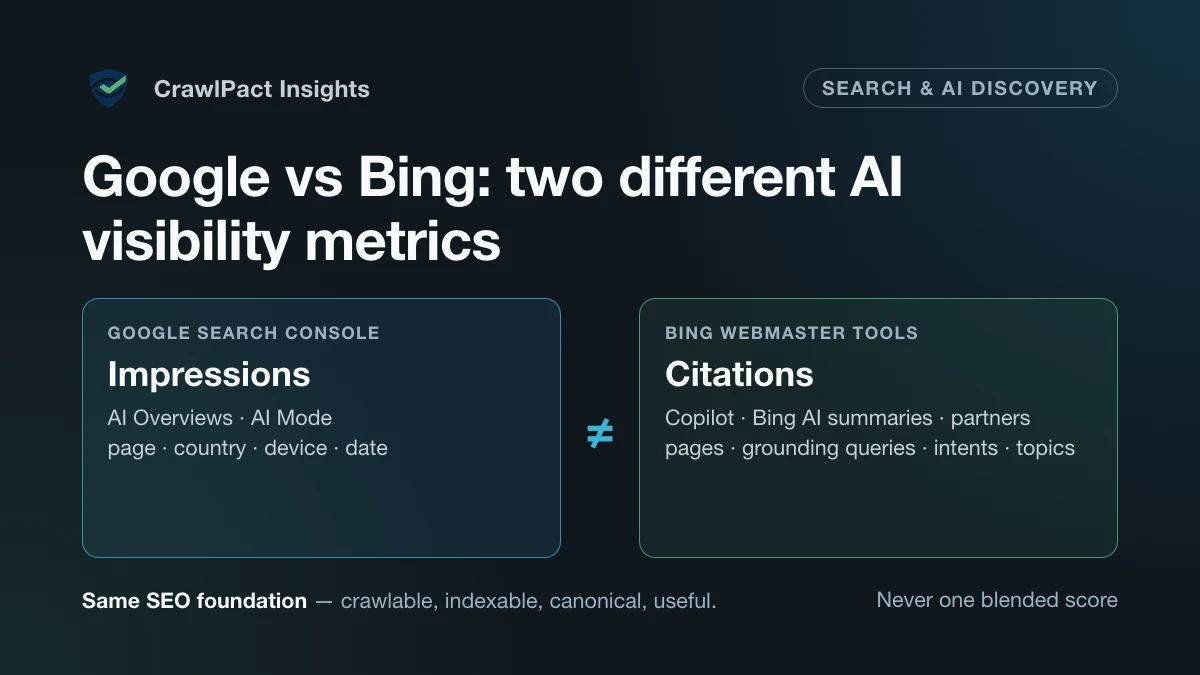
Google and Microsoft now both give site owners first-party visibility into generative AI search — but they do not measure the same thing. Google’s generative AI performance report counts impressions: links to your site shown in AI Overviews and AI Mode. Bing’s AI Performance report counts citations: your content visibly referenced as a source in Microsoft Copilot, AI-generated summaries in Bing and select partner experiences, with grounding-query context and newer preview metrics such as Citation Share.
The practical conclusion. Use the same technical SEO and content-quality foundation for both ecosystems, but keep their measurements separate. A Google generative AI impression is not a Bing citation, and neither should be folded into a home-made “AI visibility score.”
The measurement difference in one table
As documented by each vendor on 30 September 2026:
| Area | Google Search Console | Bing Webmaster Tools |
|---|---|---|
| Primary AI signal | Impressions: links to your site shown in a generative AI feature | Citations: your content visibly referenced or shown as a source in an AI answer |
| Surfaces | AI Overviews and AI Mode (Discover has its own report) | Microsoft Copilot, AI-generated summaries in Bing, select partner integrations |
| Page-level view | Yes — pages receiving generative AI impressions | Yes — citation counts by URL |
| Country and device | Yes — both are report dimensions | Not documented as report dimensions |
| Query or retrieval context | No query dimension; Google describes query fan-out but does not expose fan-out queries | Grounding queries, plus Intents and Topics (preview) |
| Relative citation presence | Not documented | Citation Share (preview): your % of citations for one grounding query |
| Period comparison | Date ranges and the performance report’s comparison filters; export | Compare (preview) overlays two periods; CSV/Excel export |
| Data caveats | Chart aggregated by property, table by page; newest data preliminary | Sampled and aggregated; totals can differ between views |
| What it is not | Not a clicks, position or query report | Not rankings, traffic, authority, importance or a quality score |
The shared foundation is still SEO
The reporting differences should not hide how closely the two agree on fundamentals. Google says SEO best practices “continue to be relevant because our generative AI features on Google Search are rooted in our core Search ranking and quality systems.” Bing’s Webmaster Guidelines say “Bing and Copilot search experiences rely on the same core crawling, indexing, and ranking foundation as traditional search.”
For both, the defensible strategy is the same: publish something worth retrieving, make it technically accessible, make its subject unambiguous, and maintain it when the underlying facts change.
Where the engines differ operationally
The largest operational difference is not a content trick. It is how a publisher can signal change.
- Google: discovery for ordinary editorial pages runs on crawlable links, XML sitemaps,
canonical consistency and normal crawling. Google’s Indexing API is not a general publishing API
— Google restricts it to pages with
JobPostingorBroadcastEvent-in-VideoObjectstructured data. - Bing: the same foundations, plus explicit support for IndexNow, which lets a publisher notify participating engines that a URL was added, updated or deleted. Bing’s guidelines list IndexNow alongside XML sitemaps, crawlable internal links and external links as the ways Bing discovers URLs.
The detail is in IndexNow vs XML sitemaps.
What “visibility” means on Google
A Google generative AI impression means a link to your site appeared to a user in a supported generative Search experience — an exposure measure. It answers: which pages appear, in which countries, on which devices, and how is that changing?
It does not reveal the retrieval path. Google explains that generative Search can use query fan-out — “a set of concurrent, related queries generated by the model” — but Search Console does not expose those queries. Reverse-engineering invisible fan-out behaviour from one impression trend is guesswork.
What “visibility” means on Bing
Bing starts from a different event: the visible citation. When a URL is shown as a source in a supported AI answer, that citation counts. The report then adds grouped retrieval context through grounding queries and, in preview, classification through Intents and Topics.
Citation Share adds a relative layer — your share of citations for one grounding query — and Microsoft rejects the tempting readings: it does not represent rankings, traffic or a quality score, and it does not reveal who holds the rest of the share.
Do not combine unlike metrics into one score
A single “AI visibility score” appeals because leadership likes one number. It is also easy to make meaningless: if one engine counts link impressions and the other counts visible citations, adding or averaging them discards exactly what makes each useful. A better model keeps three layers apart:
- Discovery and eligibility — are important URLs canonical, crawlable, indexable, internally linked and technically healthy?
- AI and search visibility — Google generative AI impressions and Bing citations, each read with its own native dimensions.
- Business impact — visits, tool use, audit starts, qualified leads, account creation or whatever your product’s real outcomes are.
This keeps reporting honest. Visibility can rise without conversion; conversion can rise while impressions are flat; an indexing problem can suppress both. Each layer calls for different action.
Same quality bar, engine-specific feedback
Google’s guide asks for non-commodity content built on real experience and warns against creating separate content for every possible search or fan-out variation to manipulate rankings or generative AI responses. Bing’s guidelines stress clear topical focus, evidence, descriptive structure, freshness and user intent, and its report shows which themes and intents attract citations.
Those positions are complementary. A strong publication programme does not write a “Google version” and a “Bing version” of the same article. It writes one canonical, high-value page, then uses each engine’s reporting to learn how that page is discovered and reused.
A monthly dual-engine review
For a site like CrawlPact, a practical monthly review looks like this:
- Google — generative AI impressions by page, country, device and date; act only on movers where volume supports it.
- Bing — total citations, cited pages and grounding queries; then Intents, Topics, Citation Share and Compare where the preview features are populated.
- Technical — sitemap and indexability health, crawl errors and material
robots.txtchanges in both Search Console and Bing Webmaster Tools. - Content — whether a visibility change lines up with a real information improvement, source update, new first-party evidence or better internal linking — not cosmetic edits.
- Product — whether readers continue into free tools or audits, and whether that leads to real activation.
Fast discovery is not durable visibility
Both ecosystems benefit when important updates are discovered quickly. But a sitemap entry or an
IndexNow notification does not create authority, does not guarantee indexing, and does not turn
weak content into a citable source. Accurate lastmod values, direct internal links and timely
change notifications tell engines what changed; original evidence and clear writing give them a
reason to keep using the page.
The strategic balance
The strongest cross-engine strategy is deliberately boring: one canonical page per user intent, primary-source evidence, real information gain, fast HTML, clean internal links, accurate dates and a transparent product boundary. Then let each engine tell its part of the story — Google about generative AI impressions, Bing about citations and grounding context, your own analytics about whether any of it created value. The mistake is forcing three stories into one number.
CrawlPact sits in the first layer only: it audits the crawler-policy signals a site publicly declares. It does not measure either engine’s visibility or rankings, and it cannot guarantee a citation.
Sources
Claims about vendors, protocols and standards trace to these sources, last verified . Statements about CrawlPact's own systems are CrawlPact's first-party observations.
- Generative AI performance report (Search)Google Search Console Help · Official documentation
- Google's guide to optimizing for generative AI features on Google SearchGoogle Search Central · Official documentation
- Indexing API quickstartGoogle Search Central · Official documentation
- AI Performance in Bing Webmaster ToolsBing Webmaster Tools Help · Official documentation
- New AI Visibility Insights in Bing Webmaster Tools: Intents, Topics, Citation Share, CompareBing Search Blog · Official documentation
- Bing Webmaster GuidelinesBing Webmaster Tools Help · Official documentation
Related CrawlPact resources
Check what your website currently declares to crawlers
CrawlPact audits the public crawler-policy signals a site exposes — robots.txt groups, robots meta and X-Robots-Tag directives, and related declarations — against a source-backed crawler registry. It does not guarantee crawler compliance, search ranking or AI citation, and it does not measure actual crawler traffic.
Audit a domainSpotted an error or an outdated source? Report it through CrawlPact's corrections process.