 CrawlPact
Bing AI Performance: Intents, Topics, Citation Share and Compare Explained
By CrawlPact · Published · Sources verified
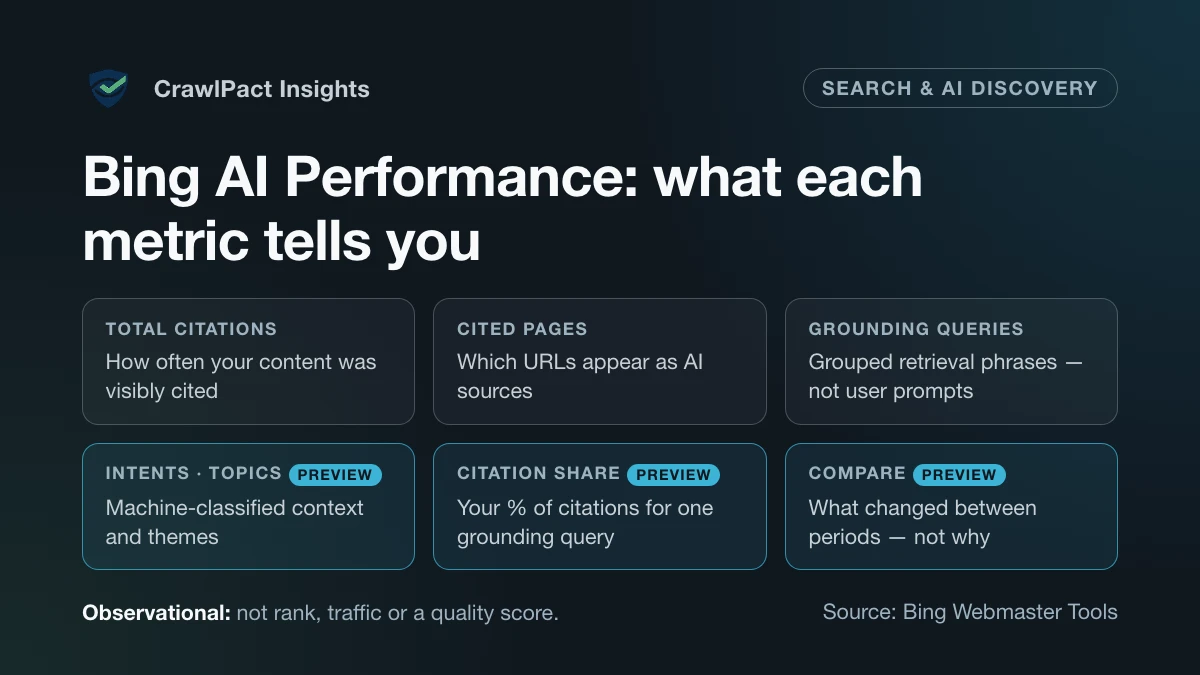
Bing Webmaster Tools gives publishers something traditional search dashboards were never built for: a first-party view of when their pages are visibly cited in AI-generated answers. Microsoft introduced AI Performance in public preview on 10 February 2026 and, on 16 June 2026, added four preview capabilities — Intents, Topics, Citation Share and Compare — which Microsoft says are rolling out “in preview within Bing Webmaster Tools globally.”
Key takeaway. Bing AI Performance is a citation-observability system, not an AI ranking score. Its value is showing which pages and themes are cited, the retrieval context associated with those citations, and how that activity changes over time. Microsoft states plainly that it “does not measure rankings, authority, performance, or importance.”
The base report
AI Performance covers three kinds of surface: Microsoft Copilot, AI-generated summaries in Bing, and select partner AI integrations. Its core views, as Microsoft’s help page defines them:
- Total citations — “the total number of times your content was visibly referenced or shown as a source in AI-generated answers” in the selected range;
- Cited pages and average cited pages — unique pages cited on a given day, and the average per day over the range;
- Grounding queries — “the key phrases the AI used when retrieving content that was referenced in AI-generated answers”;
- Page-level citation activity — citation counts by URL, which Microsoft says “reflects how often pages are cited, not their importance, ranking, or role within a response.”
Data refreshes daily with a short delay, and exports are available as CSV or Excel.
Grounding queries are not user prompts
The grounding-query view is the most useful part of the report and the easiest to misread. Microsoft describes each row as a grouped phrase: “They are not full user questions or prompts.” The data “does not show individual AI answers, exact prompts, or why a specific page was referenced,” may be phrased differently across AI experiences and partners, and “represents a sample of overall citation activity.” Very sparse citations may not surface at all, which Microsoft says “does not indicate a penalty or exclusion.”
So a phrase such as “AI crawler policy” is thematic context, not proof that someone typed those three words. One grounding query can map to several of your pages, and one page can sit under several grounding queries; the report’s query-to-page mapping lets you filter either way. It is built for pattern analysis, not prompt surveillance.
Because the data is sampled — and grounding queries and pages may be sampled over slightly different windows — Microsoft notes that a citation count for the same query and page can differ depending on which you filter by first. Totals can also differ between the page, query and time-series views. Neither is a data error.
Intents: context beyond the phrase
Intents classify grounding queries by the kind of task behind them. Microsoft’s help page lists Informational, Media, Navigational, Commercial, Learn and Solve, Research, Live Event, Local, Comparison, Planning, Utility, Creation, Conversational and Other.
That is useful because similar phrases can carry different goals. A Comparison intent may call for a structured side-by-side; a Planning intent for a sequence of decisions; a Research intent for data, methodology and primary sources. Microsoft suggests this kind of format alignment itself — comparison tables for Comparison, step-by-step guidance for Planning — while adding that such insights “do not guarantee citation outcomes.”
The labels are machine-classified. Microsoft says a query “may be assigned an intent label that does not perfectly match how you would characterize it, particularly for ambiguous or multi-intent queries.” Use Intents as a planning signal, not ground truth.
Topics: from phrases to themes
Topics group related grounding queries into broader clusters — Microsoft’s example maps “solar panels”, “solar energy efficiency” and “residential solar installation” to a Solar Energy topic. That is often the better unit for editorial planning, because strong sites build coherent coverage of a subject rather than one phrase at a time. Topics are also classifier-assigned and, during the preview, can be broad for niche or specialised domains.
Apply Topics by comparing the theme with the real depth of your site. If a topic repeatedly produces citations but you have one thin page on it, deeper, non-duplicative coverage may be justified. If you already have several strong pages, better internal links and maintenance are usually the right move — not another URL.
Citation Share: useful, and easy to overstate
Citation Share is “the percentage of citations attributed to your site out of all citations shown for a specific grounding query.” Total citations measure volume; Citation Share measures relative presence within one query’s citation space. A site can have many citations and a modest share if a query cites many sources, or fewer citations and a high share in a narrow context.
Not a ranking. Microsoft calls Citation Share “an observational metric – not a ranking system or a competitive scoreboard.” It “does not represent rankings, traffic, or a quality score,” and it does not reveal which other domains hold the rest of the share. Shifts can come from “user demand, content changes across the web, model updates, freshness signals, and partner refresh cycles.”
Microsoft offers a reading guide — high and stable, high but declining, low on a core query, growing — and is explicit that a change after a content update “does not establish a causal link.”
Compare: what changed, not why
Compare overlays a previous period on the current chart — the last 30 days against the prior 30, say, or two custom ranges. It is the right tool for before-and-after observation around a major update or a shift in demand. Microsoft’s own FAQ answers the obvious question directly: Compare “does not explain why the change happened.”
If citations rise after a rewrite, the defensible conclusion is “citation activity increased after the change,” not “the rewrite caused the increase.” A stronger inference needs a longer window, knowledge of other changes, stable demand and supporting page-level evidence.
An interpretation table
| Signal | Useful question | What not to conclude |
|---|---|---|
| Total citations | How often was our content visibly referenced? | That we ranked first, or received that many visits |
| Cited pages | Which URLs take part in AI answers? | That uncited pages are low quality or penalised |
| Grounding queries | Which retrieval themes are associated with our citations? | That these phrases are exact user prompts |
| Intents | Which broad user goals surround the cited query context? | That the classifier is always right |
| Topics | Which larger themes drive citation activity? | That every topic needs a new page |
| Citation Share | How large is our relative presence for one grounding query? | That it is traffic share, rank, authority or quality |
| Compare | How did citation activity differ between two periods? | That the chart shows why it changed |
Diagnose content; don’t manufacture it
Microsoft’s recommendations for using the data — align with user intent, deepen expertise, improve structure and clarity, support claims with evidence, keep content fresh, stay consistent across formats — suit a disciplined content programme. None of them requires volume.
Suppose a site were cited for a cluster of research-oriented queries about AI crawler policy. The strong response is to check whether the cited page has enough primary evidence, clear distinctions between crawler purposes, and links to canonical crawler references. Publishing five near-identical pages to chase five grounding-query variants would dilute intent ownership rather than strengthen it — and Bing’s own guidelines warn that duplicate URLs “dilute signals and reduce Bing’s confidence in selecting a URL for grounding results or citations.”
Indexing and content controls still decide eligibility
AI Performance does not sit outside Bing’s normal discovery and indexing. Microsoft says the report “reflects only content that is eligible for indexing” and that Bing respects preferences expressed “through robots.txt and other supported control mechanisms.”
Bing’s Webmaster Guidelines separate the controls precisely:
- “robots.txt controls crawl access, not indexing”;
- use NOINDEX “when a URL should NOT appear in Bing search, Copilot experiences, or grounding API results”;
- NOSNIPPET and DATA-NOSNIPPET stop Bing showing captions and “may limit Copilot citation quality”;
- NOCACHE “limits Copilot to using only the URL, title, and snippet”;
- NOARCHIVE “prevents content from being used in Copilot responses and grounding results.”
These directives are real content-owner choices, and a publisher may want them. But they should be deliberate, not generic privacy or SEO switches added by habit — on a page you want cited, they work directly against that goal. CrawlPact’s robots.txt vs. meta robots vs. X-Robots-Tag guide covers where each mechanism applies, and CrawlPact’s own Bing Site Scan case study shows what happens when crawl and index signals disagree.
A workflow for content teams
- Export a stable period of AI Performance data rather than reacting to one-day swings.
- Review the most-cited pages and ask what makes them useful: original evidence, clear definitions, comparison structure, freshness or topical fit.
- Read grounding-query and Topic patterns for the context in which the site is cited.
- Use Intents to check whether a page’s format matches the apparent task.
- Track Citation Share directionally for strategically important queries — never as a rank.
- Use Compare around meaningful updates, and log the other changes that could explain a shift.
- Connect citation visibility to first-party outcomes. Microsoft’s FAQ is explicit that a citation “does not represent traffic, clicks, or user engagement”; report it as awareness, never as a conversion.
Where CrawlPact fits
CrawlPact audits the crawler-policy signals a site publicly declares — robots.txt groups, robots
meta and X-Robots-Tag directives and related declarations — and compares them with a
source-backed crawler registry. It does not see Bing Webmaster Tools data, measure citations or
rankings, or guarantee that any crawler honours a rule. What it can show is whether the
declarations that decide eligibility say what you intend. Bing’s report can then show where your
eligible, useful pages are actually being cited.
For how Bing’s citation model differs from Google’s impression-based report, see Google vs Bing AI search visibility.
Sources
Claims about vendors, protocols and standards trace to these sources, last verified . Statements about CrawlPact's own systems are CrawlPact's first-party observations.
- AI Performance in Bing Webmaster ToolsBing Webmaster Tools Help · Official documentation
- Introducing AI Performance in Bing Webmaster Tools Public PreviewBing Webmaster Blog · Official documentation
- New AI Visibility Insights in Bing Webmaster Tools: Intents, Topics, Citation Share, CompareBing Search Blog · Official documentation
- Bing Webmaster GuidelinesBing Webmaster Tools Help · Official documentation
Related CrawlPact resources
Check what your website currently declares to crawlers
CrawlPact audits the public crawler-policy signals a site exposes — robots.txt groups, robots meta and X-Robots-Tag directives, and related declarations — against a source-backed crawler registry. It does not guarantee crawler compliance, search ranking or AI citation, and it does not measure actual crawler traffic.
Audit a domainSpotted an error or an outdated source? Report it through CrawlPact's corrections process.