 CrawlPact
IndexNow vs XML Sitemaps: What Each One Does for Search Discovery
By CrawlPact · Published · Sources verified
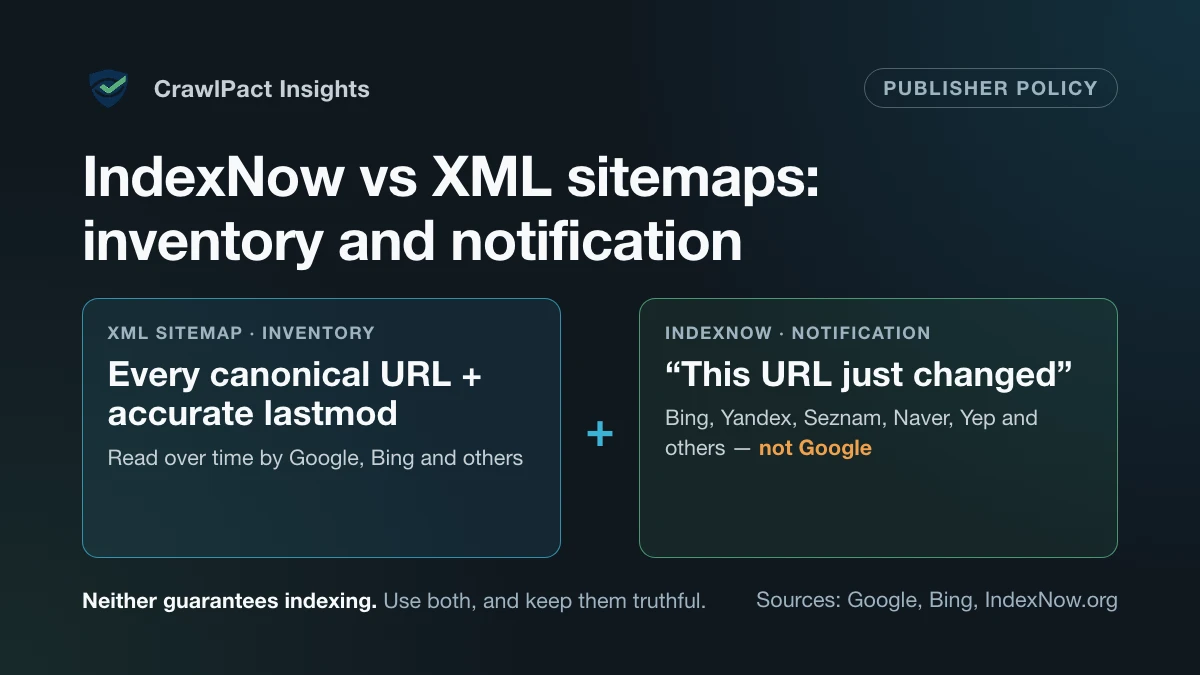
IndexNow and XML sitemaps are often described as competing ways to “get indexed faster.” That framing is wrong. They solve different parts of the discovery problem and, for the search engines that support IndexNow, work best together.
The simple distinction. A sitemap is a structured inventory of the canonical URLs you want a search engine to know about, revisited over time. IndexNow is a notification: it tells participating search engines that a specific URL was just added, updated or deleted. Neither guarantees indexing.
What an XML sitemap does
An XML sitemap is a machine-readable list of the URLs you consider important and canonical. A single sitemap holds up to 50,000 URLs or 50 MB uncompressed; larger sites split into several files under a sitemap index.
The signal that matters is the quality of the inventory, not the number of files:
- Canonical URLs only. Google asks you to list the URLs you want to see in Search; Bing’s guidelines say sitemaps should “list only canonical URLs,” reflect current site structure and “remove deleted or redirected URLs promptly.”
- Truthful
lastmod. Google useslastmod“if it’s consistently and verifiably (for example by comparing to the last modification of the page) accurate,” and says it should reflect the last significant update — main content, structured data or links, not a copyright-year bump. Bing’s July 2025 guidance callslastmod“a key signal” for deciding what to recrawl. - No
priorityorchangefreqtheatre. Google says it ignores both; Bing’s July 2025 post says they “are ignored by Bing.”
One formatting nuance: Bing’s post recommends full ISO 8601 date-and-time values, while Google’s
own sitemap example uses a plain date (2022-06-04). A date alone is valid. If your content is
edited on a daily editorial cadence, a truthful date beats an invented time of day.
A good sitemap answers two questions: which public URLs should the engine know about, and which of them changed in a way that matters? It is not a publication feed for every CSS tweak.
What IndexNow does
IndexNow is a push protocol. When a page is added, substantially updated, redirected or deleted, a site submits the URL to an IndexNow endpoint. The FAQ says a submission to one participating engine is shared with all IndexNow-enabled engines.
The protocol is explicit about limits. Its documentation says a 200 response “only indicates that the search engine has received your URL” (a 202 means received, with key validation pending). The FAQ adds that “each engine makes its own decision about whether to index it,” and that submitting “does not guarantee immediate indexing.” Every submitted URL also counts toward your site’s crawl quota.
IndexNow does not replace the inventory. Its FAQ says it is “intended for notifying search engines about recently added, updated, or deleted URLs” and not for submitting every URL at once (a full resubmission is reasonable after a migration or redesign); “for ongoing discovery and long-term indexing, use an XML sitemap.”
Which search engines each applies to
As of 30 September 2026, IndexNow.org’s list of participating engines is Microsoft Bing, Yandex, Seznam.cz, Naver, Yep, the Internet Archive and Amazon’s Amazonbot. Google is not on it.
For Google, ordinary editorial discovery still comes from crawlable links — Google says it can
generally only follow a link that is an <a> element with an href — from sitemaps, and from
Google’s normal crawling. That is why a cross-engine site should never build an “IndexNow-only”
workflow: a new page still needs an internal link and a sitemap entry for durable discovery.
Don’t confuse IndexNow with Google’s Indexing API
Google does have an Indexing API, and its name causes recurring confusion. Google’s documentation
says it “can only be used to crawl pages with either JobPosting or BroadcastEvent embedded in a
VideoObject.” A normal article, product guide or SaaS page is not an eligible use case.
For an ordinary page, the Google workflow is conventional: publish a crawlable canonical URL, link
to it internally, list it in the sitemap with an accurate lastmod, and use Search Console’s URL
Inspection selectively when an important new page needs checking.
A side-by-side decision table
| Mechanism | Primary job | Best use | Guarantees indexing? |
|---|---|---|---|
| XML sitemap | Complete canonical URL inventory, with freshness hints | Every important indexable URL, including rarely changed | No |
| IndexNow | Tell participating engines a URL just changed | New, materially updated, redirected or deleted URLs | No |
| Search Console URL Inspection | Diagnose one URL and optionally request crawling | A few high-priority pages that need checking | No |
| Google Indexing API | Notify Google about eligible short-lived pages | JobPosting and BroadcastEvent-in-VideoObject pages only |
No |
A workflow for publishing a new article
- Publish the final canonical URL. Confirm it returns 200, is indexable and is not blocked in
robots.txtfor the crawlers you care about. - Link to it with a normal
<a href>from a relevant indexed page, such as a hub or related article. - Add the canonical URL to the XML sitemap.
- Set
lastmodfrom the publication or last significant content update — never the deploy timestamp of an unrelated CSS or footer change. - Notify IndexNow participants, directly or through infrastructure that does it for you.
- For Google, let normal crawling work. Use URL Inspection selectively for important launches rather than trying to push ordinary pages through the restricted Indexing API.
- Monitor real indexing and visibility; a successful submission is not success.
When an existing page changes
Signal only meaningful change. If an article gains a new analysis section, its underlying facts
change, or its structured data or links change substantially, refresh lastmod and notify
IndexNow. A typo, colour or copyright-year change should not masquerade as a content update.
IndexNow’s FAQ advises against resubmitting the same URL many times a day and says unnecessary
submissions “may lead to wasted crawl quota without improving visibility.”
When a URL is removed or redirected
A deletion is a change too. Remove the old URL from the sitemap, return the right status (404 or 410) or a permanent redirect, update internal links, and notify IndexNow — its FAQ says redirected and deleted URLs should be submitted. Leaving redirected or deleted URLs in a sitemap creates conflicting instructions: the sitemap says “current canonical page,” the server says “moved” or “gone.”
Does every section need its own sitemap?
Usually not. Splitting is useful when URL volume demands it or when segmentation genuinely helps diagnosis. Dividing a small site into many files creates no ranking advantage. A new content section can live in the existing sitemap until it is large enough that separate reporting is actually useful — the trigger should be observability, not superstition.
Avoid duplicate submission systems
If a platform or CDN already sends IndexNow notifications for you, verify that coverage before adding a second publisher. Two systems submitting the same change add complexity without necessarily adding value, and duplicates spend crawl quota.
CrawlPact is served through Cloudflare with Cloudflare’s Crawler Hints enabled. Cloudflare documents that Crawler Hints uses a cache MISS as the sign that content has likely changed and reports it to IndexNow, and that it will not report a response with “an HTTP status code greater than 4xx.” Because CrawlPact’s public pages are edge-cached, a new URL’s first request is a MISS. CrawlPact therefore relies on that mechanism and has not built a second IndexNow client; submissions are checked in Bing Webmaster Tools rather than assumed. Crawler Hints is a signal heuristic, not a publishing hook — it is exactly the kind of coverage worth verifying rather than trusting.
Discovery is a system
Fast discovery comes from consistent signals, not a magic endpoint. A strong public page is linked
from the site, listed accurately in the sitemap, canonical, crawlable, indexable — and worth
indexing. IndexNow can make change discovery faster for participating engines, but it cannot
repair contradictory robots.txt rules, thin content, duplicate URLs or a broken canonical
architecture. CrawlPact’s own
Bing Site Scan case study shows what
one contradictory signal looks like in practice.
For Google and Bing alike, the durable strategy is the same: publish fewer, stronger canonical URLs and make every discovery signal agree about them.
Sources
Claims about vendors, protocols and standards trace to these sources, last verified . Statements about CrawlPact's own systems are CrawlPact's first-party observations.
- Build and submit a sitemapGoogle Search Central · Official documentation
- Link best practices for GoogleGoogle Search Central · Official documentation
- Indexing API quickstartGoogle Search Central · Official documentation
- Bing Webmaster GuidelinesBing Webmaster Tools Help · Official documentation
- Keeping Content Discoverable with Sitemaps in AI Powered SearchBing Webmaster Blog · Official documentation
- IndexNow documentationIndexNow.org · Official documentation
- IndexNow FAQIndexNow.org · Official documentation
- Participating search engines (searchengines.json)IndexNow.org · Official documentation
- Crawler HintsCloudflare Docs · Official documentation
Related CrawlPact resources
Check what your website currently declares to crawlers
CrawlPact audits the public crawler-policy signals a site exposes — robots.txt groups, robots meta and X-Robots-Tag directives, and related declarations — against a source-backed crawler registry. It does not guarantee crawler compliance, search ranking or AI citation, and it does not measure actual crawler traffic.
Audit a domainSpotted an error or an outdated source? Report it through CrawlPact's corrections process.