 CrawlPact
Insight · Search & AI discovery
Google Preferred Sources in AI Mode and AI Overviews: What Publishers Can Actually Influence
Google Preferred Sources can highlight a site in AI Mode and AI Overviews for readers who choose it. What publishers can influence, and what they cannot.
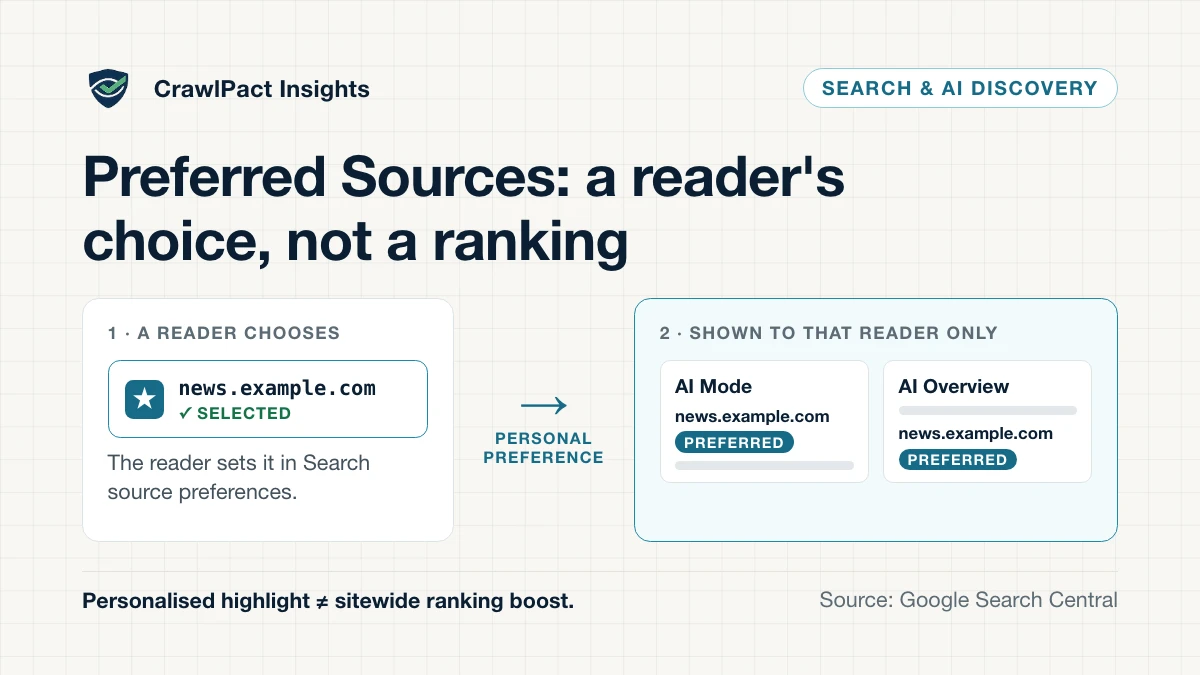
Google Preferred Sources is a personalisation feature. A reader chooses the websites they value, and Google can then make those sources easier to spot for that reader — in Top Stories and, since 27 May 2026, inside AI Overviews and AI Mode, where links from a chosen source can carry a “Preferred” badge.
For publishers the opportunity is real but narrower than much of the commentary suggests. You can keep your site eligible, keep publishing fresh, useful content, and make the choice easier for readers. You cannot make a reader choose you, make Google cite you, or turn one reader’s preference into a ranking change for everyone else.
Key takeaway. Preferred Sources changes what one reader sees after that reader makes a choice. Google documents it as a badge and, in Top Stories, extra prominence for the person who selected the site — not as a ranking factor, an indexing route or an AI-citation guarantee.
What Preferred Sources actually changes
Google’s publisher documentation describes two different effects, and the difference matters:
- Top Stories: when a user selects your site, “your content is more likely to appear in ‘Top Stories’, highlighted with a ‘preferred’ badge.”
- AI Mode and AI Overviews: “your content can be highlighted with a ‘preferred’ badge for users who have selected your site as a preferred source.”
For Top Stories, Google describes a change in prominence for the selecting user. For AI Mode and AI Overviews, the documented effect is a label on the chosen source’s links: Google’s May 2026 announcement says readers “will be able to easily spot links in AI responses from the sources you’ve already selected.” The same announcement says a new link carousel for some developing-topic questions will also highlight Preferred Sources.
The preference belongs to the reader. Google’s help page explains that a reader sets it in the “Search personalization” settings or from the Top Stories header, that one choice tailors Top Stories, AI Mode and AI Overviews together, and that signed-in settings follow the reader across browsers. A publisher can invite the choice; it cannot make it.
How the feature reached AI Search
Preferred Sources has changed quickly, which is why many explanations of it are already out of date. From Google’s own posts and its documentation update log:
| Date | Change (as Google described it) | Google-reported unique sources selected |
|---|---|---|
| 12 Aug 2025 | Launched for Top Stories in the U.S. and India | — |
| 30 Jan 2026 | Publisher documentation added to Search Central | — |
| 30 Apr 2026 | Available in all languages where Google Search is available; translated button assets | over 200,000 |
| 27 May 2026 | Rolling out to AI Overviews and AI Mode | more than 345,000 |
| 20 Aug 2026 | Interactive “Preferred Sources” button that publishers can embed, returning readers to a page | more than 600,000 |
The counts are Google’s own figures as stated on each date, not CrawlPact measurements; treat them as a dated adoption signal, not as an evergreen number. Google has also reported, in April and May 2026, that people are twice as likely to click through to a Preferred Source. That is a Google observation about the readers who chose a source — not a promise that any particular site will see twice the clicks.
“Preferred for this reader” is not “ranked higher for everyone”
If one reader selects your publication, nothing in Google’s documentation says any other user sees a change. And even for that reader, Google still decides which pages are relevant to each query and whether a generative AI feature appears at all. Google’s generative AI guidance says these features “are rooted in our core Search ranking and quality systems” and that, even when a page meets every requirement, “indexing and serving aren’t guaranteed.”
That gives the central guardrail for reporting:
Reader preference → Preferred Sources eligibility → personalised highlight or badge ≠ universal ranking boost.
Do not report “we became a Preferred Source” as if the site earned a new global position. A site is preferred by individual readers, who can change their choice at any time.
What publishers can influence
Every row is grounded in Google’s documentation; the right-hand column is what that documentation does not promise.
| Publisher lever | Can the publisher influence it? | What it actually changes | What it does not guarantee |
|---|---|---|---|
| Be indexable and eligible for a snippet | Yes | Baseline eligibility for generative AI features | That Google crawls, indexes or shows the page |
| Stay included in Search generative AI features | Yes (Search Console setting) | Eligibility to show as a preferred source in AI Mode and AI Overviews | Any AI Mode or AI Overviews appearance |
| Publish fresh content regularly | Yes | Whether the site is available to choose in the source preferences tool | That anyone chooses it |
| Ask readers to select the site | Yes | The number of readers given the opportunity to choose it | A ranking change for anyone |
| Add Google’s button (standard or custom) | Yes | A shorter selection flow that returns the reader to your page | A ranking boost |
| Share the deeplink in newsletters or social posts | Yes | A direct path into the source preferences tool | An AI citation |
| A reader actually selects the site | No — only the reader can | That reader’s Top Stories prominence and the badge on links shown to that reader | Any effect for other users |
| Google chooses which links answer a specific query | No direct control | Which results and AI responses appear | Inclusion for any query |
Two of those rows rest on wording worth quoting exactly. On freshness, Google’s help page warns readers that “sources that aren’t updated regularly may not be available” in the selector, and the May 2026 announcement says “any website that publishes fresh content is eligible.” On promotion, Google’s publisher guide says the button and deeplink “are examples of how you can build your audience” and that “it’s not required to do them in order to appear as a preferred source.”
What publishers cannot control
You cannot make a reader select your site. You cannot guarantee that a selected site appears for a given query, that a link to it appears in a particular AI response, or that a “Preferred” badge is shown every time. And because Google documents no effect outside the selecting reader’s own results, you cannot infer a general ranking improvement from the feature.
Search Console does not separate it out either. The generative AI performance report counts impressions of links to your site in AI Overviews and AI Mode, by page, country, device and date; its documentation describes no Preferred Sources dimension, and Google documents no Preferred Sources publisher report.
Domain and subdomain eligibility
Google treats a whole site as the unit a reader can prefer: “Only domain-level and subdomain-level
sites are eligible to appear in the source preferences tool.” Its example: https://www.example.com/
and https://code.example.com/ are eligible, but the subdirectory https://www.example.com/blog
is not.
A media group running several titles in folders of one domain therefore cannot expect readers to prefer each folder separately. That is worth knowing when planning new properties, but it is not by itself a reason to restructure an existing site: domain architecture affects canonicalisation, internal linking, analytics and operations far beyond this one feature.
For AI Mode and AI Overviews there is a second condition. Google says that “to make your site eligible for display as a preferred source in these features, you must make sure your site is included in Search generative AI features in Search Console.” Inclusion is Search Console’s default; a site that switched the Search generative AI control to “exclude” has opted out of the AI-feature side of Preferred Sources too, while Top Stories is unaffected by that setting.
Should a publisher add the Preferred Source button?
Google offers three ways to send readers into the preference flow:
- Standard JavaScript button — Google’s recommended option: a script loaded from
news.google.complus onediv, rendering an automatically localised button. - Advanced JavaScript — the same library initialised programmatically, so the flow can start from your own design or an application milestone.
- Deeplink — a plain link to
https://www.google.com/preferences/source?q=followed by your domain, usable on a page, in newsletters or in social posts, with no script at all.
The button is reasonable for a publication with a recurring audience that would genuinely benefit from seeing it more prominently. But the two JavaScript options load a third-party script from Google, which brings performance, Content Security Policy and privacy-and-consent questions — and Google says none of the methods is required to appear as a preferred source. A deeplink gives readers the same choice without that dependency.
Four questions settle it:
- Do you have returning readers who would value seeing you more often?
- Does your site actually appear when you search for it in Google’s source preferences tool?
- Can you add the control without weakening performance, security headers or consent?
- Can you describe it accurately — “add us as a preferred source on Google”, never “boost our Google ranking”?
If the only motivation is “this might improve our AI rankings”, the premise is unsupported. (CrawlPact itself does not embed Google’s button; this article explains it without adding the script.)
How to measure the result without inventing a “Preferred Source ranking”
There is no dedicated metric, so measure the audience relationship, not a rank:
- Promotion reach: clicks on your own “add us” link or deeplink, measured in your analytics;
- Returning readers: repeat visits and newsletter or subscription conversions over weeks, not days;
- Google visibility: the Search performance report and the generative AI performance report, read as overall visibility — they cannot attribute any impression to a reader’s preference;
- Change log: the dates you added a button or deeplink, so later comparisons rest on evidence.
Do not treat a rise in generative AI impressions as proof that Preferred Sources caused it. The feature is personalised, readers can change their choice at any time, and Google exposes no per-preference data. For why Google and Bing AI reports cannot be merged into one number either, see Google vs Bing AI search visibility.
Preferred Sources sits on top of SEO, not instead of it
Google’s guidance on generative AI features is explicit that “the best practices for SEO continue
to be relevant”, that a page must be “indexed and eligible to be shown in Google Search with a
snippet”, and that “there’s no special schema.org markup you need to add.” It also treats “AEO”
and “GEO” as SEO by another name and advises ignoring tactics such as content “chunking” or
llms.txt files for Google Search.
Preferred Sources does not change any of that. It gives readers a way to say which sources they value; it does not replace the crawlable, indexable, useful pages that make a source worth choosing.
What Preferred Sources is not
Preferred Sources is often discussed alongside controls it has nothing to do with. It is not:
robots.txtor a crawler permission — it does not decide whether Googlebot may fetch a page;Google-Extended— that token manages AI-training and Gemini-grounding use of crawled content, and Google says it “does not impact a site’s inclusion in Google Search”; see Google-Extended vs Googlebot;- structured data — no markup makes a site a preferred source;
- IndexNow or an XML sitemap — those are discovery mechanisms, and Google is not an IndexNow participant; see IndexNow vs XML sitemaps;
- the generative AI performance report — that counts impressions of your links in AI features across all searchers; it does not report preferences;
- an AI-training control — choosing a source says nothing about how content may be used to train models;
- an AI-ranking score — Google documents no such score.
Keeping these layers apart prevents a common category error: audience preference is not machine-use permission.
What this means for CrawlPact users
CrawlPact audits the public crawler-policy signals a website declares — robots.txt groups, the
homepage’s robots meta and X-Robots-Tag directives and related declarations — against a
source-backed crawler registry (see the methodology). It does not see, measure or
influence Preferred Sources, reader preferences, Google rankings or AI citations.
The connection is eligibility. A preferred-source badge in AI Mode or AI Overviews can only appear
on a page that is eligible for those features in the first place, and Google’s robots meta
specification says nosnippet “will also prevent the content from being used as a direct input for
AI Overviews and AI Mode.” A stray nosnippet, an accidental noindex or a robots.txt rule that
blocks Googlebot can quietly remove the foundation a reader’s preference depends on. Declared
signals like these — robots.txt rules and the homepage’s robots directives — are what a CrawlPact
audit shows; whether readers then choose your site is up to them.
A practical publisher checklist
- Search for your domain or subdomain in Google’s source preferences tool to confirm it is listed.
- If AI Mode and AI Overviews matter to you, confirm Search Console’s Search generative AI control is set to include your site — it is by default.
- Confirm important pages are indexable and allowed a snippet: no stray
noindexornosnippet, and norobots.txtrule blocking Googlebot. - Keep publishing fresh, useful content; Google says sources that aren’t updated regularly may not be available to choose.
- Choose deeplink, standard button or custom button against your performance, CSP and consent standards — or none of them, since none is required.
- Describe the feature honestly when you promote it, and log when you started.
- Judge it over months by returning readers and conversions, not by a ranking narrative.
The takeaway
Google Preferred Sources lets readers tell Search which publications they value. That can make a chosen source more prominent in Top Stories and easier to spot, with a “Preferred” badge, in AI Mode and AI Overviews — for that reader, in the languages and locales where those features exist.
Publishers can keep their site eligible, keep it fresh and make the choice easy. They cannot turn a reader’s preference into a universal ranking or a citation guarantee. Make selection easy if it serves your audience — but do not mistake preference for rank.
Sources
Claims about vendors, protocols and standards trace to these sources, last verified . Statements about CrawlPact's own systems are CrawlPact's first-party observations.
- Help your readers find your site through preferred sources in Google SearchGoogle Search Central · Official documentation
- Preferred Sources in Google SearchGoogle Search Help · Official documentation
- New ways to find your favorite sources and original content in AI SearchGoogle (The Keyword) · Official documentation
- Personalize the content you see on Search, Discover, and NewsGoogle (The Keyword) · Official documentation
- Google Search: Preferred Sources now available in all languagesGoogle (The Keyword) · Official documentation
- How to select Preferred Sources in Google SearchGoogle (The Keyword) · Official documentation
- Latest Google Search documentation updatesGoogle Search Central · Official documentation
- Optimizing your website for generative AI features on Google SearchGoogle Search Central · Official documentation
- Search generative AI controlGoogle Search Console Help · Official documentation
- Generative AI performance report (Search)Google Search Console Help · Official documentation
- Google's common crawlers (Google-Extended)Google Crawling Infrastructure · Official documentation
- Robots meta tag, data-nosnippet, and X-Robots-Tag specificationsGoogle Search Central · Official documentation
Related CrawlPact resources
Check what your website currently declares to crawlers
CrawlPact audits the public crawler-policy signals a site exposes — robots.txt groups, robots meta and X-Robots-Tag directives, and related declarations — against a source-backed crawler registry. It does not guarantee crawler compliance, search ranking or AI citation, and it does not measure actual crawler traffic.
Audit a domainSpotted an error or an outdated source? Report it through CrawlPact's corrections process.